

September 8 – the feast of the Nativity of Our Lady – is known as “Victory Day” in Malta and is also the feast day of Our Lady of Philermo, patroness of the Order of Malta. In connection with its September 8 celebration, the Michigan Area learned about the icon of Our Lady of Philermo, and its role in critical events in Maltese history, including the famed “Great Siege” of 1565.
The link between the Order and Our Lady of Philermo goes back centuries. In 1306, the Order of St. John purchased and occupied the island of Rhodes, where the remains of a Byzantine church stood on Mount Philermos. There the Knights found an icon of Our Lady, said to have been painted by St. Luke the Evangelist. The Knights built a basilica on the spot and there housed the icon, which became known as “Our Lady of All Mercies” and “Our Lady of Philermos (Philermo).” Since that time, the Order has been devoted to Our Lady under that title as the Order’s patroness. When the Knights were expelled from Rhodes by Ottoman forces in 1522, the Knights took the icon with them to Malta.
Decades later, the icon was credited with an astounding victory of the Knights over the formidable Ottoman empire.
In 1565, it only seemed a matter of time before the Muslim Ottoman Empire, led by the redoubtable Sultan Sulieman, would have all of Europe at its mercy. The empire already had control of the eastern Mediterranean, and the Ottomans had built up their navy until, by 1565, it was the largest in the world, with about 180 ships and 40,000 fighters, including the elite Janissaries.
By contrast, the defending forces on the island of Malta numbered only 8,000 to 9,000, including about 500 Knights of the Order of St. John. Since the Knights had been driven out of Rhodes by the Ottomans after a six-month siege, the Ottomans could be confident that they could overwhelm the Knights again, especially with their now-formidable navy, and gain a pivotal naval base in the march to dominate Europe. Realizing the danger, Queen Elizabeth I wrote, “If the Turks should prevail against the isle of Malta, it is uncertain what future peril might follow to the rest of Christendom.”
Jean de Valette, Grand Master of the Order of St. John, clearly realized the daunting odds facing the Knights — but just as clearly, their duty to fight the Ottoman Empire. He exhorted his fellow Knights, “Today our faith is at stake and whether the Gospel must yield to the Koran. God is asking for the lives which we pledged to him at our profession. Happy are those who may sacrifice their lives.”
On May 18, 1565, the Ottoman navy arrived at Malta, and the Great Siege began. After a month-long series of assaults, the Ottoman forces succeeded at taking the Maltese fort of St. Elmo, but lost at least 6,000 soldiers, including half their Janissaries. When the Ottomans entered the fort, they found fewer than 10 Knights alive, and those were mortally wounded.
Despite continuing attacks on other Malta fortresses and cities, the Knights and their allies withstood the siege. According to legend, a white dove came to rest on the icon of Our Lady of Philermo, housed in the Church of San Lorenzo in Birgu, Malta. The dove remained seated on the icon for hours as a sign that the island would soon be delivered from the siege. Christian reinforcements eventually arrived, and on September 8, 1565, the remaining Ottoman forces left Malta, having lost at least three-quarters of their troops.
Jean de Valette was later buried in the Maltese city he founded, Valletta, and honored as “the scourge of Africa and Asia and the shield of Europe.” So celebrated was the victory that Voltaire later wrote, “Nothing is more known than this siege, where the fortune of Sulieman failed.”
September 8 also marks the end of the Siege of Valletta by the French (1798-1800) during the reign of Napoleon. And during WWII, Malta was under siege yet again, this time by Italian Axis forces bombing the island over three years. The siege was lifted on September 8, 1943 when Italy capitulated to the Allies. The Maltese credit all these victories to Our Lady’s intercession, hence the title, “Maria Bambina il-Vitorja,” Our Lady of Victory, and the observance of September 8 as “Victory Day.”
The icon of Our Lady of Philermo has moved with the Order: When Napoleon expelled the Knights of St. John from Malta, the Knights took the icon with them. The icon went to Russia, then to Denmark, Yugoslavia, and finally Montenegro. Thought to be lost, the icon was discovered in 1997 and is now on view in the Montenegro National Museum in Cetinje.
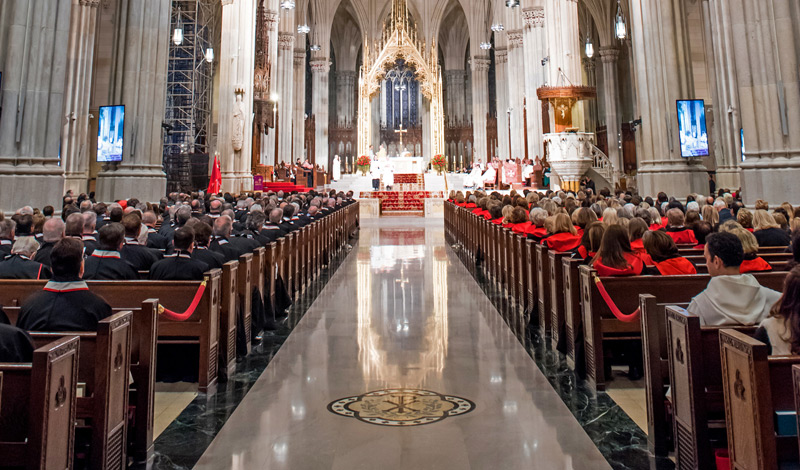
The Michigan Area’s well-attended September 8 celebration took place at St. Owen Catholic Church in Bloomfield Hills, where Michigan Area chaplain Msgr. Michael LeFevre, ChM, is pastor.
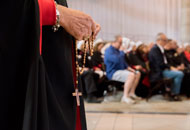
Due to the Labor Day holiday, the Michigan Area did not hold its usual First Saturday the previous weekend. Instead, the September 8 evening event followed the First Saturday format, beginning with a Rosary led by Michigan Area Chair Andy Smith, KM, who also led the Order’s Daily Prayer. Many Area members came early to avail themselves of the opportunity for Confession.
Msgr. LeFevre celebrated Mass; Associate John Micallef proclaimed the first reading, and the Responsorial Psalm was sung by Lauren Andree, daughter of Carolyn Andree, DM. David Closs, KM, and Noel Closs, DM, offered the Prayers of the Faithful.
Afterwards, Michigan Area members enjoyed food and fellowship. A display included an icon of Our Lady of Philermo, normally housed at the Cathedral of the Most Blessed Sacrament in Detroit, brought to the event by Sean Shriner, KM. Sean and Auxiliary Jenna Shriner provided the hospitality.
Follow the Michigan Area on FaceBook, Instagram, LinkedIn, and X.
