
October is a month that, by tradition, has a focus on our Blessed Mother, especially the devotion known as the rosary. Perhaps we can have a type of refresher course on devotions to our Blessed Mother. We can therefore reflect on the various prayers and devotions to Mary, our Blessed Mother: what are these prayers, why do we have them, how did they come about and what is the meaning of them…? We also know that the Order has Our Lady of Philermos as our patroness and that part of the spirituality of the Order is the devotion to the Immaculate Heart of Mary.
Devotions to Our Lady can help us to focus upon, and to renew, our faith. The various “mysteries” of the rosary remind us of the great events in the life of Christ, and of His role as Saviour and sole meditator between God and humanity. As one document notes: “the Rosary, though clearly Marian in character, is at heart a Christ-centred prayer.” Marian Devotions also help us to reflect on the mystery of the Trinity: of what God has done for us and how we are part of God’s plan. Mary is also seen as a model and example of the Church, and so Marian Devotions help us to grow in our appreciation of the mystery of the Church. In other words, Mary is seen as the first disciple of Christ, and the Church models her earthly journey on that of the Mother of God and the Mother of the Church. She is the sign of our future, of our hope of life in heaven.
The Rosary, especially since the time of Pope Leo XIII in the early twentieth century, has been greatly commended and encouraged to this day. We also have the memoria of Our Lady of the Rosary in our Church’s calendar on 7th October. The great thirteenth century saint, St. Dominic, is often seen as the originator of the Rosary. We know that in the Middle Ages, strings of beads called ‘paternosters’ were used to help prayer in church or when walking or riding along. (Often it was the Pater Noster, the Our Father, that was repeated). Monks used to recite all one hundred and fifty psalms that are found in the Bible. At some stage, the “Hail Mary” was substituted for the 150 psalms (the three mysteries and five decades making that number), or the Our Father. When and how this occurred is not exactly known.
The Rosary is very much a prayer of contemplation and it models Mary’s own prayer of remembering (“she pondered all these things in her heart”; Luke 2: 19). It is also described as a very “human” method of praying, based upon the idea that a repetition of prayers or phrases can help us to clear our minds and so focus on the mysteries of our faith. The rosary is very much a compendium of the Gospel because we reflect upon the various events or “mysteries” in the life of our Lord and of Mary. It is for this reason that the new luminous mysteries were added by Pope St. John Paul II. He took this initiative because there appeared to be a “gap” in including the mysteries of Jesus’ public life between His Baptism and His Passion in the traditional mysteries (the joyful, the glorious and the sorrowful mysteries). These new mysteries therefore are:
I. Jesus’ Baptism in the Jordan
II. His self-manifestation at Cana (Jesus’ “first” miracle)
III. His proclamation of the Kingdom of God and call to conversion
IV. His Transfiguration
V. His institution of the Eucharist
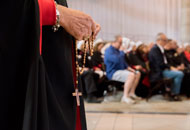
This month might be a great time to revisit the rosary as a form of prayer. After all, we can pray the rosary anywhere, either using the traditional beads or by using a rosary ring. There are even CDs and various downloads of the rosary available to play in the car (while driving with due care and attention, of course!).
A couple of helpful resources to deepen our understanding of the rosary include:
Pope Saint John Paul II, Apostolic Letter, Rosarium Virginis Mariae on the “Most Holy Rosary” (you can download the English version of this from the Vatican website)
N. Mitchell The Mysteries of the Rosary: Marian Devotions and the Reinvention of Catholicism (N.Y.: University of New York Press 2009)
Beyond the Rosary, there are many other devotions and prayers centred upon our Blessed Mother, as part of our Catholic tradition in general, and very much part of the spirituality of the Order. Perhaps we can now expand things somewhat, by taking a brief look at some of them…
The best know devotional prayer is, of course, the “Hail Mary” (the Ave Maria in Latin…often set to song and a favourite at key events such as weddings or funerals). It is important to recall that the prayer is really a set of Scripture references (from the coming and greeting of the Archangel Gabriel to Mary at the Annunciation in Luke 1: 26-38 and then our Lady’s Visitation to her relative Elizabeth), followed by a petition for prayer, “Holy Mary, Mother of God, pray for us…”
Another devotion, the Angelus, was approved by Pope John XXII in 1318. Originally it was said in the evening only, then in the morning, and finally also at midday. This prayer (usually accompanied by the ringing of bells with three sets of three and then a longer peal) reminds us of the great events of the annunciation of Jesus’ birth to Mary (Luke 1: 26-38). It is a great way to pause at certain moments of the day to pray. You can even download apps that will toll the Angelus bells for you as a reminder! The use of the another prayer, the Regina Caeli (“Queen of Heaven Rejoice”) during Eastertide as a substitute for the Angelus was recommended in the early seventeenth century so as to help us focus on the joyous events of Easter. In these devotions, we concentrate upon the great mysteries of our faith: the birth of Jesus in the incarnation, Jesus’s life, death, resurrection and ascension, the coming of the Holy Spirit and the birth of the Church, and the future life in heaven.
A further devotion, the Litany of Loreto, was composed around 1500. It was adopted by the shrine of the Holy House at Loreto, and its use spread from there through the visits of pilgrims. It was approved for general use in 1587. It contains a series of fervent praises in honour of the Blessed Virgin Mary. Like many Marian Litanies, it contains elements from Sacred Scripture and from many Medieval poems and hymns to Mary. Pope Francis added three new petitions to this Litany. There is also a very beautiful prayer of intercession called the Memorare (taken from the first word of the prayer in Latin…”Remember, O Most Gracious Virgin Mary…”). The prayer was composed by St. Bernard some 900 or so years ago and has been used over the centuries as a special prayer asking the help and intercession of our Blessed Mother for special needs or situations.
We can also recognise the place of Mary in many other areas such as in our Church’s liturgical year. There are so many examples of this. For instance, there are many feast days devoted to our Blessed Mother. She is mentioned in the Mass (during the Eucharistic Prayer) and in the other sacraments (for example, the Litany of Saints or the Profession of faith used at Baptisms and Confirmations). She is also called upon in the various rites and sacramentals that we use in the Church (for example the Prayer for Mourners in the Funeral Rite) and in the Divine Office (for example, the canticle or hymn called the Magnificat, based on Luke 1: 46-56). In all these, the same rationale for Marian Devotion as we reflected upon earlier appears again: her special place in the mystery of the Trinity and the mystery of the Church, and her role as example and intercessor for us.
Pope Francis renewed the consecration of the world to the “Immaculate Heart of Mary” and the US Bishops did the same back in June of this year (as part of the 250th anniversary of independence celebrations). This is another devotion or title of our Blessed Mother that is associated with the shrine at Fatima in Portugal (google it to find out more!). The devotion reminds us of how Mary’s heart was pure and undivided, being totally focussed on doing God’s will and on love of God and neighbour. Remember that the “heart” in spiritual terms, stands as a symbol for our will, our values and attitudes: in other words, for all that drives and motivates us. We too are called to have that same focussed, generous and undivided heart, especially in our work for the Order.
During this month of October, let us take up the suggestion to deepen our devotion to Mary, Mother of God; that she may help us to grow in our understanding of our faith and in our relationship with her Son, our Lord. In addition, as we pray at the conclusion of the Hail Mary: “…holy Mary, Mother of God, pray for us sinners now and at the hours of our death, Amen.”
The Very Rev. Msgr. Anthony M. Barratt, STL, PhD, VF, ChM
