



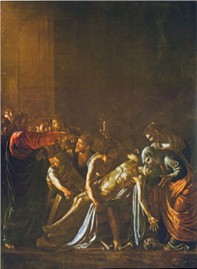
The Raising of Lazarus
The readings from Sacred Scripture for the Fifth Sunday in Lent bring us face to face with the mystery and painful reality of death. In fact, all of our readings today and are also ones that can be chosen for a funeral Mass. In the preceding verses of Chapter 37 of the Book of the Prophet Ezekiel, Ezekiel has a vision of a valley of dry bones that are brought to life by God’s Spirit. Then our reading begins (Ezekiel 37: 12-14) as we hear the prophecy that God will open the graves and raise His people. This prophecy, is of course, fulfilled in Jesus’ death and resurrection. Saint Paul, in his letter to the Romans (Romans 8: 6-11), brings home this point as he writes that those who are dead to sin can be alive through righteousness and that the Spirit who raised Jesus from the dead will also give life to our mortal bodies. On another level, he also wishes to remind us that it is the Spirit that animates and gives life to our body. In the Gospel (John 11: 1-45), we hear of the last and greatest of the seven “signs” worked by Jesus that St. John, in his Gospel, wishes us to see: Jesus raising Lazarus from the dead. Jesus is indeed “the resurrection and the life.”
As we read about the death of Jesus’ friend Lazarus, we also encounter the full and familiar spectrum of human emotions that accompany loss and bereavement. Take, for example, Lazarus’ two sisters Mary and Martha. Mary is so upset that she cannot leave the house, whereas Martha, ever practical, greets Jesus and questions him. We meet another human reaction when some in the crowd shake their heads and pointedly ask why Jesus did not save his friend. In our Gospel we have the full gambit of human life and all its emotions! We should also grasp the full reality of Lazarus’ death. The fact that he has been in the tomb for four days means that he is decomposing (Jesus is warned of the stench) and it was a belief that the spirit truly leaves the body after three days. Jesus has raised others such as the daughter of Jairus, or the son of the widow of Nain, but they had been dead for just a few hours. What will happen this time…?
Jesus becomes the focus, as he works this last great “sign” (remember that St. John’s Gospel is sometimes called the “Gospel of Signs”). There is a beautiful interplay between the humanity and the divinity of Jesus in the Gospel. Humanly, Jesus is deeply moved (we might translate his feeling as “gut wrenching”!) and we have those two, short, profound words that “Jesus wept”. Interestingly, several different and powerful words are used to describe Jesus’ emotions and these are rare in John’s Gospel. They also occur later on when Jesus is betrayed and when he hangs upon the cross. Jesus has indeed experienced all that humans can feel; not as a pretense or show, but really: grief, death, betrayal, abandonment, pain, hunger and thirst. In this sense, he is truly our brother.
But Jesus is also truly God, consubstantial with the Father. Jesus has already given one of the “I am” sayings that we find in John’s Gospel to show his divinity. He calls Lazarus out of the tomb and restores Lazarus to life. The bonds of death (symbolized in the burial bands that enwrap Lazarus) are undone and he is released and free again. We might also say that he restores Martha and Mary back to new life too, for the death of a loved one can make us “die inside.” The artist Caravaggio in his 1609 painting of the scene captures this so beautifully. Jesus, bathed in light, points and commands Lazarus to rise from the dead. A discolored, pale, rigid and lifeless Lazarus is held tenderly by his grieving sisters; but in this, they will be the first to experience the warmth returning to his body and that first breath of new life. The artist indicates this beautifully in the returning light of life that first bathes the sisters.
Jesus is our resurrection and life. Our readings, of course, remind us of our faith in the promise of resurrection when our life’s journey is complete. We hope for this for ourselves, but also for our loved ones who have gone before us. This new life is not just for the future however. Jesus, the resurrection and the life, brings life to us now when our spirit is dying and so unbinds us from things that hold us in bondage such as addictions, anger, bitterness or hurts. We might then say that our future hope of resurrection begins right now. As our Lord said, “I have come that they may have life, and have it more abundantly” (John 10: 10). With this in mind, let us repeat and live Martha’s words: “yes Lord, I believe…”
Very Rev. Msgr. Anthony M. Barratt, STL, PhD, ChM
