



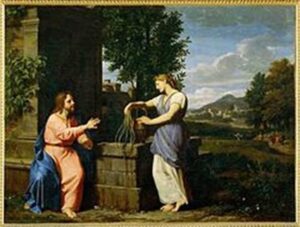
Jesus Meets the Woman at the Well
Last Sunday, we reflected on our Gospel of the Transfiguration of Jesus in St. Matthew’s Gospel. We explored how those three pillars of Lent (prayer, fasting and acts of charity), with God’s grace, can transfigure or transform us. This year, as we continue our journey through Lent, perhaps we change tack in our reflections and use the medium of art as a way to unpack the various Gospels that we hear on Sunday. From now on, each Sunday, we will hear from St. John’s Gospel, often called “the Gospel of Signs.” St. John lays before us a number of encounters between Jesus and others. In each encounter, we see a “sign” of both who Jesus is, but also who we should be. After all, any encounter with the Lord should not leave us unchanged: in fact, it should be a life-changer!
This week, we are presented with a very human and yet very dramatic Gospel as Jesus meets the Samaritan woman at Jacob’s well. An everyday and rather mundane task of fetching water becomes, for the woman, a life-transforming encounter as she meets Jesus and enters into a conversation with him. Ultimately, that conversation becomes also a conversion for her: she drinks from the water of eternal life. Here is our first lesson. How often God comes to us in the ordinary or mundane and transforms that ordinary situation into something extraordinary: if we have eyes to see and ears to hear.
The French artist Nicolas Colombel (1644-1717) was very taken with this Gospel story and so he painted a beautiful picture of the encounter between Jesus and the woman). Colombel wants those who look at his painting not just to see a picture of this encounter, but to be transported into it. When this happens, we can better understand all that is going on and so learn from the event and apply it to our own lives.
So, what can we notice in his painting…? First of all, we notice the realism. The city can be seen in the distance, as the encounter would have taken place outside the town, at the well of Jacob. Also; notice how there are virtually no shadows and the scene is brightly lit. This is because the woman came to the well at noon, in the heat of the day, since no one else would be there. Why was this? She went to the well at this time because she was despised and shunned by the townspeople as a woman of bad repute. Some artists make this point by showing the woman as scantily dressed, but Colombel does this by showing her as not covering her hair: a “good” woman would always go outside with her hair covered and this would have been a very strict custom at the time of Jesus. Some commentators also think that all the rope gathered in her hand (presumably to let the bucket down into the deep well) is also a symbol of the entangled life that she had lead up to this point.
We can also see the animated conversation between the Jesus and the woman in their gestures and in the fluid movement of their bodies. We can easily see how Jesus reaches out towards the woman and how animated his face seems to be. It is a sure sign of his thirst: not for water (although he would have been hot and thirsty in the noonday heat), but rather his thirst for the woman’s soul and for her conversion to a new life. Jesus gently, but surely, moves towards the woman, to encourage her and to welcome her, just as the Lord makes the first move towards us as he thirsts for our soul and life too.
By contrast to this moving and tranquil scene, we can see in the distance on the right hand side of the picture, the flustered disciples hurrying towards Jesus, no doubt wondering what on earth he is doing talking with this person of ill-repute. Here we should learn that sometimes, judgments about others, even if well-meaning, can actually be a barrier or a hindrance to God’s love and mercy working in a situation or in a person.
In this our third week of our journey of Lent together, let us be open to Jesus’s love and thirst in our life. Let us engage in conversation (prayer) with him, just as the woman at the well did and, like her, welcome his healing presence into our lives so that our conversation with Jesus turns into our conversion. We might also realize that Jesus asks us to be his hands and feet (to paraphrase St. Teresa of Avila), that is to be his agents or instruments of conversion in others.
The Very Rev. Msgr. Anthony Barratt, STL, PhD, ChM
